
Menu

Why Enterprises Are Rethinking Hyperscaler-Only Cloud
Public cloud changed the way organizations think about infrastructure. It made it easier to launch new applications, scale on demand, and innovate faster without massive upfront investment.
But as cloud environments grow and mature, many enterprises are discovering that a hyperscaler-only strategy is not always the most efficient, predictable, or controllable path forward. Instead of defaulting to “cloud everywhere,” IT leaders are becoming more intentional about where workloads live — choosing the right environment for each application based on cost, performance, risk, and long-term operational goals.
Key Takeaways
-
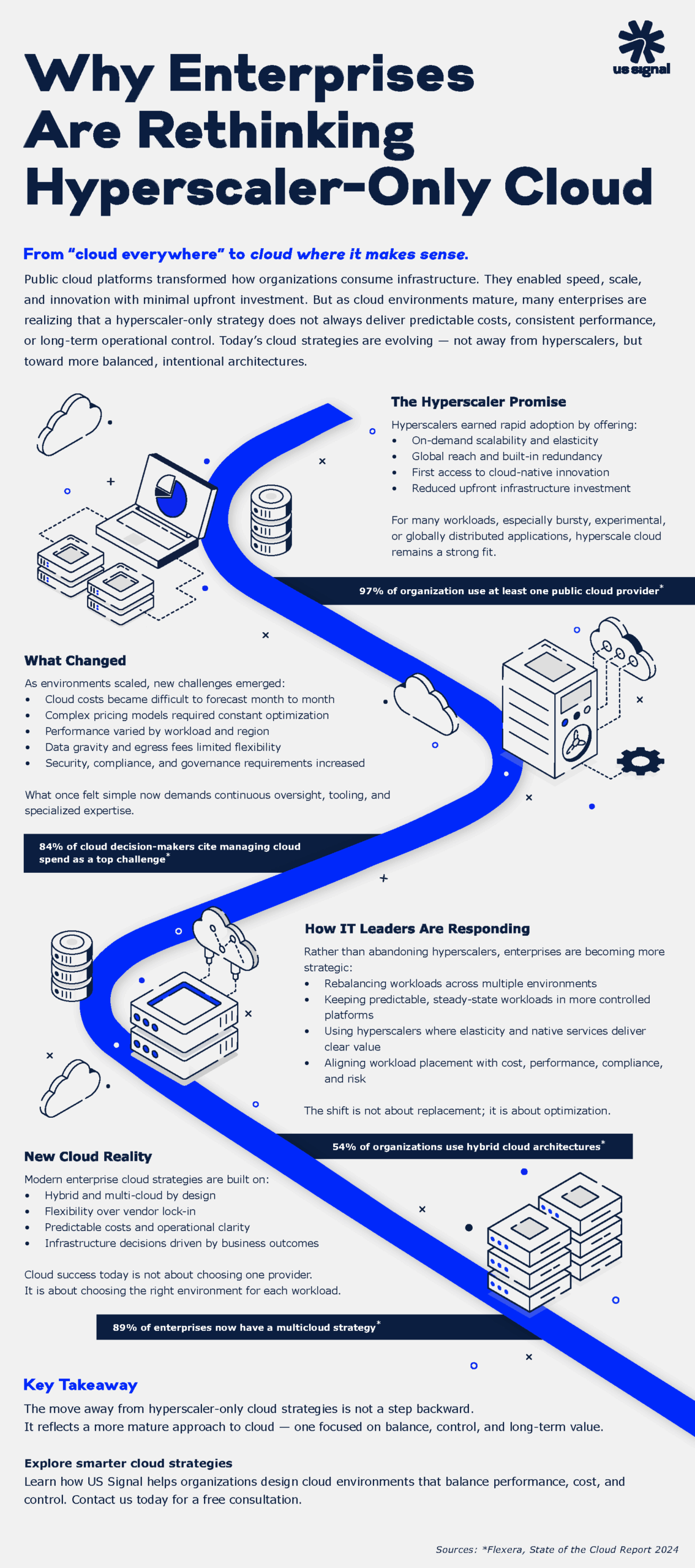
97% of organizations use at least one public cloud provider*
-
84% of cloud decision-makers cite managing cloud spend as a top challenge*
-
54% of organizations use hybrid cloud architectures*
-
89% of enterprises now have a multicloud strategy*
Related Resources


Why Enterprises Are Rethinking Hyperscaler-Only Cloud
From “cloud everywhere” to cloud where it makes sense
Public cloud platforms transformed how organizations consume infrastructure. They enabled speed, scale, and innovation with minimal upfront investment.
But as cloud environments mature, many enterprises are realizing that a hyperscaler-only strategy does not always deliver predictable costs, consistent performance, or long-term operational control.
Today’s cloud strategies are evolving — not away from hyperscalers, but toward more balanced, intentional architectures.
The Hyperscaler Promise
Hyperscalers earned rapid adoption by offering:
- On-demand scalability and elasticity
- Global reach and built-in redundancy
- Fast access to cloud-native innovation
- Reduced upfront infrastructure investment
For many workloads — especially bursty, experimental, or globally distributed applications — hyperscale cloud remains a strong fit.
What Changed
As environments scaled, new challenges emerged:
- Cloud costs became difficult to forecast month to month
- Complex pricing models required constant optimization
- Performance varied by workload and region
- Data gravity and egress fees limited flexibility
- Security, compliance, and governance requirements increased
What once felt simple now demands continuous oversight, tooling, and specialized expertise.
How IT Leaders Are Responding
Rather than abandoning hyperscalers, enterprises are becoming more strategic:
- Rebalancing workloads across multiple environments
- Keeping predictable, steady-state workloads in more controlled platforms
- Using hyperscalers where elasticity and native services deliver clear value
- Aligning workload placement with cost, performance, compliance, and risk
The shift is not about replacement; it is about optimization.
The New Cloud Reality
Modern enterprise cloud strategies are built on:
- Hybrid and multi-cloud by design
- Flexibility over vendor lock-in
- Predictable costs and operational clarity
- Infrastructure decisions driven by business outcomes
Cloud success today is not about choosing one provider. It is about choosing the right environment for each workload.
Key Takeaway
The move away from hyperscaler-only cloud strategies is not a step backward.
It reflects a more mature approach to cloud — one focused on balance, control, and long-term value.
Explore smarter cloud strategies
Learn how US Signal helps organizations design cloud environments that balance performance, cost, and control. Contact us today for a free consultation.


Get the Latest Insights
Subscribe to our newsletter for valuable insights and resources delivered right to your inbox.